Also Known As St. Aidan
St. Máedóc of Ferns – 13th February
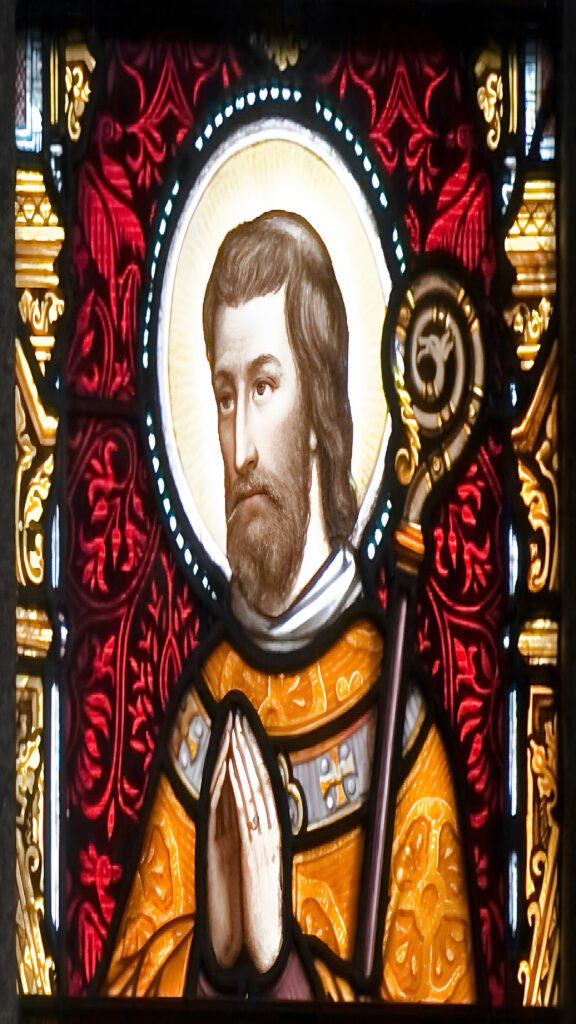
St. Máedóc, also known as St. Mogue or Madoc, and more famously as St. Aidan (Not the same as St. Aidan of Lindisfarne), was an Irish saint, the first Bishop of Ferns in County Wexford, and the founder of 30 churches! His birth name was Áed. Áed was also the name of the Irish God of the underworld; Aidan is a diminutive form of the name. He was often called Mo Aodh Óg, which means ‘My little Áed’. This name became Aidan when Anglicised.
Aidan was born circa 558 in Templeport, County Cavan. He, like many Irish saints, was the son of royalty. In the case of Aidan, his father was Sedna, Chieftain of Connaught, and his mother was Eithne. Interestingly, as you read these lives of Irish saints, you may notice they were all related to one another in one way or another. Aidan’s first cousin was St. Dallán Forgaill.
Childhood & Adolescence
As a child, the Bell of St. Mogue was given to Aidan by St. Caillín, who would go on to teach Aidan after baptising him. On the day of his baptism, a boat could not be found to take the baby Aidan across the lake to where St. Caillín awaited him, so the infant was placed on a slab of rock and floated across the lake. This stone was later used to create a font in the tiny village of Bawnboy in County Cavan.
Later in his adolescence, Aidan was kidnapped by Ainmuire mac Sétnai, a member of the Uí Néill clan. However, Ainmuire was so impressed by Aidan that he told him he could leave and have his freedom, but Aidan said he would only leave if the other hostages that were kidnapped with him could leave too. Ainmuire acquiesced to the request and freed all of them.
Aidan ended up studying at the famed school of St. Finnian at Clonard Abbey in County Meath. While there, he became good friends with Saint Laisrén mac Nad Froích, who would go on to found the monastery on Devenish Island on the River Erne in Northern Ireland.
Around this time, although he was young, people began seeking his spiritual guidance and help. However, Aidan felt he had much to learn still, so he fled to Wales, where he studied under the famous St. David of Wales. He is even named in Welsh historical documents as one of David’s most faithful disciples. An interesting fact recorded of Aidan is that when he fled, he brought his own beer from Ireland with him to Wales!
Return to Ireland & Miracles
In 570, Aidan returned to Ireland, bringing with him some hives of honey bees, which he was told were scarce on the island at that time (nowadays honey bees are abundant in Ireland, perhaps thanks to this small effort by St. Aidan). As he landed in Wexford, he saw some locals robbing a group of strangers, and he intervened. What he did, we do not know, but his response so impressed the local Chieftain that he gifted him land for religious communities. Eventually, he settled in Leinster, where he fasted for seven years, consuming only barley bread and water.
After this, he went on to Ferns in County Wexford, where he established a monastery, and due to his humility and benevolence, he was made chief bishop of Leinster. On one occasion, an example of his famous benevolence is when he fed beef to hungry and tired bishops visiting from Britain. This was during Lent, so the bishops were surprised and tried to refuse; however, St. Aidan reasoned with them, saying that the beef was only grass and water in condensed form, whereas the whey and biscuits consumed by the monks had so many insects on them that it would cause ‘conscientious scruples’.
On one occasion, when going to get ale for some monks, he dropped the jug and broke it, but when he made the sign of the cross over the jug, it was repaired, and he continued with his task.
Another time, he was given a yoke for his oxen that was deliberately too small. This was done by St. David’s steward, who hated St. Aidan and even tried to kill him at one point. However, the yoke, when used by Aidan, fit the oxen perfectly, much to the steward’s dismay.
On another occasion, a beggar asked Aidan for some food while Aidan was milling flour. The saint obliged him, but later, when the beggar disguised himself as a blind man and returned asking for more food, Aidan cursed him, telling him every generation of his descendants would have a blind member.
Many other miracles are attributed to St. Aidan, including the withering of a murderer’s hand, helping a king overcome his enemies in battle, and helping an Irish architect have a successful career.
Love For Animals
During his life, his love for animals was evident. While other Irishmen at that time loved to hunt, Aidan loved to help and care for animals. On one occasion, while reading, a desperate stag approached him and took refuge with him for safety from the hounds of hunters who were in pursuit. Aidan made the stag invisible, and the hounds lost the trail and gave up. Due to this, he is often depicted as a stag in artwork.
There was a time when a wolf ate a calf, and the calf’s mother was overcome with grief. Aidan blessed the head of the cook and told him to offer it to the heifer. The heifer licked his head and loved the cook as she would have loved her calf for the rest of her life.
Legacy
Aidan died on January 31, 632. He was buried in St. Edan’s Cathedral in Wexford. His relics are currently in the possession of the National Museum of Ireland.
St. Aidan is the patron saint of Ferns, Wexford, and Templeport in Cavan. Even today, the name Aidan is very popular in Ireland. St. Aidan is so loved in Wales that they have even attempted to claim him as one of their own, but the historical evidence does not strongly support this claim.
In Welsh tradition, it is believed that St. David of Wales died in St. Aidan’s arms after St. Aidan returned to Wales for a brief visit. It is very possible that this happened, as the two saints had a very close relationship.
St. Aidan’s legacy lives on strongly in Ireland and Wales, a testament to a great Orthodox saint who communicated with animals, fed the hungry, brought the wrath of righteous anger on sinners, and befriended the greatest saints of Ireland and Britain in his lifetime.