Early Life
Finnian of Clonard – 25th December
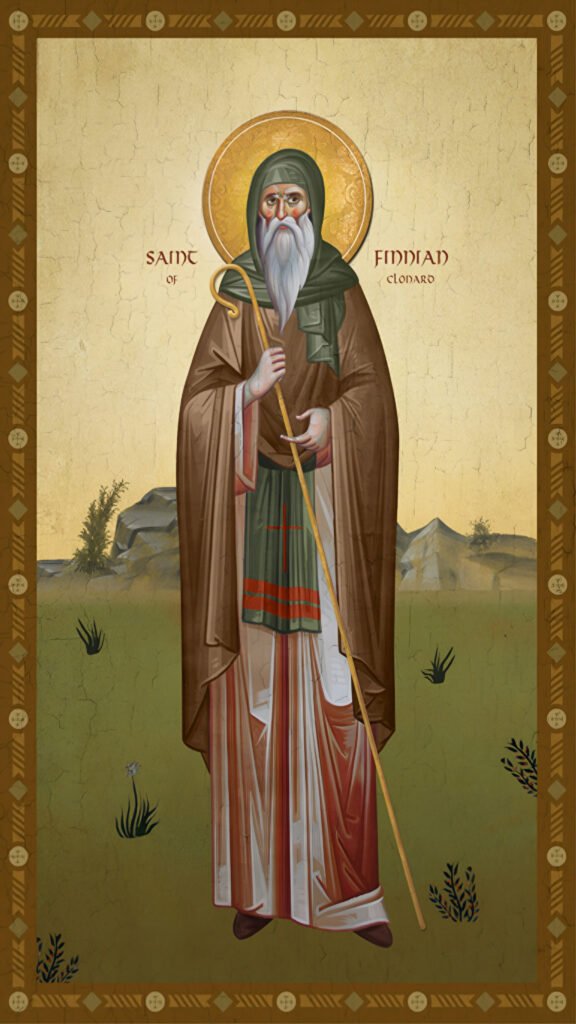
Finnian of Clonard, one of the early Irish monastic saints, was the blessed founder of Clonard Abbey in County Meath. He was born in County Carlow in the Kingdom of Leinster in 470, a member of the Clanna Rudraige tribe, which originated in Ulaid, Northern Ireland. This is the Ulaid that was defeated in battle several times over a week by the Three Collas. Finnian was baptised by Abban and was then placed in the care of Bishop Fortchern of Trim.
It is possible he also studied under Martin of Tours in Gaul. We know for a fact that he journeyed to Wales and studied at the monastery of Cadoc the Wise at Llancarfan. He remained there for possibly 30 years, but it is unlikely he was away from Ireland for that long, considering all of his achievements upon his return. While in Wales, he dedicated himself to fasting, prayer, and the diligent copying of Rome’s classics and St. Jerome’s Vulgate.
Return to Ireland
Upon returning to Ireland, he first established a monastery at Aghowle in County Wicklow, nestled at the foot of Sliabh Condala (Sliabh meaning ‘Mountain’ in Irish). This site was gifted to Finnian by the King of Leinster before the saint set off for Skellig Michael to found the famed monastery that was established upon the rock for centuries. Never one to rest on his laurels, he then moved on to St. Brigid’s Monastery in County Kildare before, in 520, an angel led him to the place of his future resurrection at Cluain Eraird, or Clonard, in County Meath, near the River Boyne.
Here, at the place chosen for his resurrection, Finnian built a simple cell and a church with wattle and clay. It was here that his asceticism deepened significantly, and his life became entirely dedicated to the mortification of the flesh, fervent study, and prayer. Due to his renowned holiness, he was soon inundated with scholars, seekers of Christ, and locals who sought his spiritual guidance and help.
Establishing A Monastery
Eventually, this influx led him to establish a formal monastery in Clonard. The monastery of Clonard was rigorous, based on the traditions of the Desert Fathers and the intense study of the Scriptures. Life at Clonard was known for its strictness and asceticism, though there was also time for devoted work in the scriptorium and/or the craft workshop at the site. One example of the asceticism practised there was Finnian sleeping on the cold floor and wearing an iron girdle as penance.
Despite the difficulty of life at Clonard, over 3,000 students received instruction at the abbey. This impressive number of students is often attributed to the profound skill of Finnian’s teaching. He possessed a deep understanding of Scripture and was able to impart knowledge in a way that deeply engaged his students and ignited within them a greater hunger to learn. Among his many students were numerous future missionaries and the twelve Apostles of Ireland.
St. Finnian reposed in the Lord in 549 from the plague and was buried in his own church at Clonard. His school remained a beacon of learning for generations, as many of its alumni went on to found monasteries in both Ireland and abroad. Eventually, due to invasion and war, his abbey was destroyed along with his resting place, and his relics were lost. He remains to this day the patron saint of County Meath.
His sister, Regnach, also went on to become the Abbess of Kilreynagh near Banagher, County Offaly.