Máel Ruain of Tallaght
Máel Ruain – 20th July
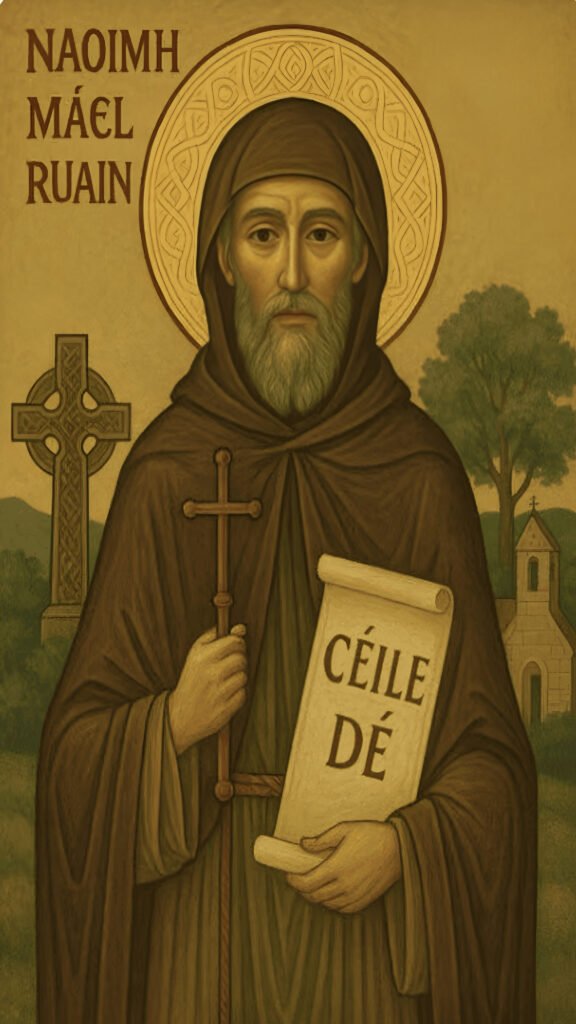
Our Holy Father Máel Ruain was the founder, abbot, and bishop of the God-protected monastery of Tallaght in Dublin, established in the year of our Lord 755. This sacred dwelling was built upon land graciously provided to him by Cellach Mac Drunchada, who reigned as King of Leinster during that time.
Saint Máel Ruain shared a profound and pious friendship with the venerable Saint Óengus of Tallaght. Together, these two holy men compiled the esteemed Martyrology of Tallaght. Through their combined efforts and spiritual endeavors, Saints Máel Ruain and Óengus are renowned for guiding the form of sacred scholarship known as the ‘Céile Dé’ (Companions of God).
Early Life
While the details of Saint Máel Ruain’s early life remain largely unknown to us, including his baptismal name, we know ‘Máel Ruain’ is his monastic designation. The name ‘Máel’ signifies ‘tonsured one’ in Old Irish, while ‘Ruain’ means ‘of Rúadán’. This latter part may suggest he received his initial spiritual formation or training at the monastery of Saint Rúadán in Lothra, located in County Tipperary. It is believed that this holy man was born in the region of Tipperary around the year 720.
In an epilogue appended to the Martyrology of Tallaght, written after the blessed repose of Saint Máel Ruain, Saint Óengus lovingly recalled his spiritual tutor, describing him as “the great sun on Meath’s south plain.”
The Rule of Céile Dé
Regrettably, many of his sacred teachings have been lost to the passage of time. However, mention is made of a spiritual guide he composed, known as “The Rule of Céile Dé.” This venerable book sets forth numerous rules and standards for the monastic life. As this sacred text is not presently accessible, further specific details cannot be offered here. Nevertheless, research indicates that his monastic rule closely mirrored the rigorous spiritual discipline practiced by the holy Desert Fathers.
It was Saint Máel Ruain’s discerning view that Irish monasticism of his era had somewhat departed from the strict asceticism and discipline of previous generations, becoming perhaps less fervent. Therefore, he established “The Rule of Céile Dé” to restore and strengthen the standards of monastic life.
The precise reasons for this perceived decline in monastic standards are not definitively known. However, it is widely considered that the fervent missionary zeal and the tradition of wandering in self-imposed exile, characteristic of earlier Irish saints, may have inadvertently led to challenges regarding discipline within the monasteries. When the most zealous and spiritually advanced men and women are frequently departing for mission or solitary exile, fewer exemplary figures remain within the monastic community for the succeeding generations to emulate.
By the 9th century, this intense missionary fervor and desire for wilderness wandering had somewhat subsided. Yet, unfortunately, it seems that fewer individuals fully understood the profound commitment and practices required to live a truly devout monastic life. It is likely for this reason that Saint Máel Ruain, in his spiritual wisdom, gently discouraged his students from embarking on overseas expeditions.
In his efforts to revitalize monastic life, Saint Máel Ruain re-introduced the blessed practices of frequent confession, lengthy fasts, strict asceticism, and challenging penances. These included standing for periods in freezing cold water, a demanding physical discipline intended to aid in subduing the passions and strengthening the will.
He was widely recognized as a teacher of great spiritual depth and was deeply respected by his contemporaries. His students, guided by his holy example and teachings, traveled throughout Ireland and into Europe, spreading the light of Christ.
Saint Máel Ruain, our holy Father, reposed in the Lord on the 7th day of July in the year 792, leaving behind a legacy of monastic reform and spiritual guidance.