St. Brigid of Kildare: Patroness of Ireland and Pioneer of Female Monasticism
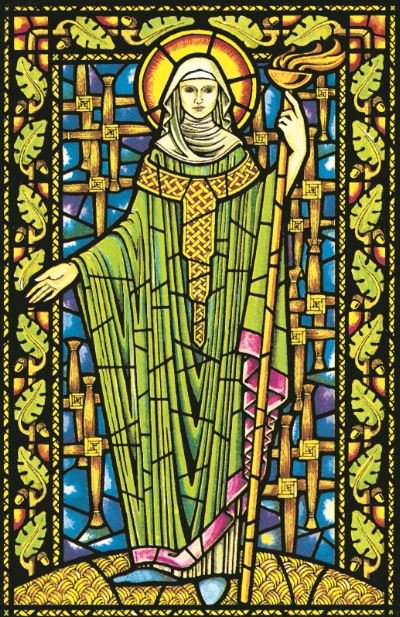
Saint Brigid of Kildare (c. 451–525), known in Irish as Naomh Bríd, stands among the most prominent and consequential figures in early medieval Irish Christianity. One of Ireland’s three national patron saints alongside Patrick and Columcille (Columba), she is venerated as a healer, protector of livestock, patroness of learning, and most significantly as the founder of communal religious life for women in Ireland and a monastic leader of extraordinary influence.
Origins and Family Background
She was born around 451, likely at Faughart near Dundalk in County Louth, though an alternative tradition locates her birthplace at Ummeras near Kildare. Her father, Dubhthach, was a chieftain of Leinster of considerable political standing, while her mother, Broicsech, occupied an unusual and poignant position in the household: she was a Christian slave, reportedly baptised by Saint Patrick himself, who had been sold into bondage when she became pregnant.
Broicsech, gave birth to Brigid while carrying milk into her druid master’s household at dawn while standing on the threshold. Her birth happening at the threshold is seen as symbolising her connection to Ireland’s pagan past and Christian future. When the druid attempted to feed the newborn Brigid, she vomited due to his spiritual impurity; instead, a white cow with red ears arrived miraculously to sustain her.
As Brigid matured within this complex household, her reputation for extraordinary sanctity developed. Many accounts of her holiness accumulated around her childhood, including the account that she gave away her mother’s entire butter store to feed the poor, after which the butter was replenished through God’s divine grace. Around age ten, she was returned to her father’s household as a servant, where her compulsive charity continued to disturb Dubhthach, who found his precious possessions systematically donated to beggars and the poor.
The Cloak Miracle and Path to Religious Life
Eventually, Dubhthach became so exasperated by his daughter’s charitable impulses that he took her to the King of Leinster with the intention of selling her into service to remove her from his household. While her father negotiated with the king, Brigid encountered a beggar and, characteristic of her habitual generosity, gave away Dubhthach’s most prized possession: his jewelled sword, which she bartered for food to sustain the beggar’s family.
The King of Leinster, recognising Brigid’s extraordinary holiness and the futility of her father’s attempt to profit from her, persuaded Dubhthach to grant his daughter freedom to pursue her spiritual vocation.
Years later, she became a consecrated virgin. There are varying accounts regarding whether Saint Mac Caille, Bishop of Cruachán Brí Éile, or Saint Mél of Ardagh performed the formal veiling ceremony, though the latter likely conferred abbatial powers. Brigid, seeking to found a monastery visited the King of Leinster to petition for land to establish a religious community. The king, apparently unmoved by her spiritual credentials, mockingly agreed to grant her as much land as her cloak would cover.
Brigid accepted the king’s seemingly ungenerous offer. She commanded four of her companions to take up her cloak, and each one turned around and began to run swiftly across the landscape in different directions. The cloak grew miraculously, covering acres of territory in every direction. The terrified king cried out: “Oh, Brigid! What are you about?” To which she replied: “I am, or rather my cloak is about covering your whole province to punish you for your stinginess to the poor.” Faced with this display of power, the king capitulated and granted Brigid a large plot of land for her monastery. The king then converted to Christianity and began to practice generosity toward the poor, while personally commissioning the construction of the convent.
Foundation of Kildare Abbey: Pioneer of Female Monasticism
Around 480, Saint Brigid established her main monastery at the site that would come to be known as Kildare, derived from the Irish Cill Dara, meaning “church of the oak.” The location was situated on the plains of Magh Life in County Kildare, near an ancient oak tree.
With an initial group of seven companions, Brigid created Ireland’s first organised communal religious life for women. Prior to this, individual women could pursue consecrated virginity and hermitic spirituality, but Brigid established the first structured, communal monastic community exclusively for women in Ireland.
The monastery rapidly grew into a double monastery with separate communities for both men and women. Brigid appointed Saint Conleth, a hermit from Connell, to serve alongside her in the governance of the community. Conleth would becomme the first Bishop of Kildare.
For centuries, Kildare was governed by a double hierarchy with an abbot-bishop ruling the male community in tandem with an abbess-bishop directing the female monastery while the Abbess of Kildare was recognised as the superior of all Irish convent communities. This made the Abbess of Kildare arguably the most powerful woman in medieval Ireland.
Kildare as a Center of Learning, Art, and Civilization
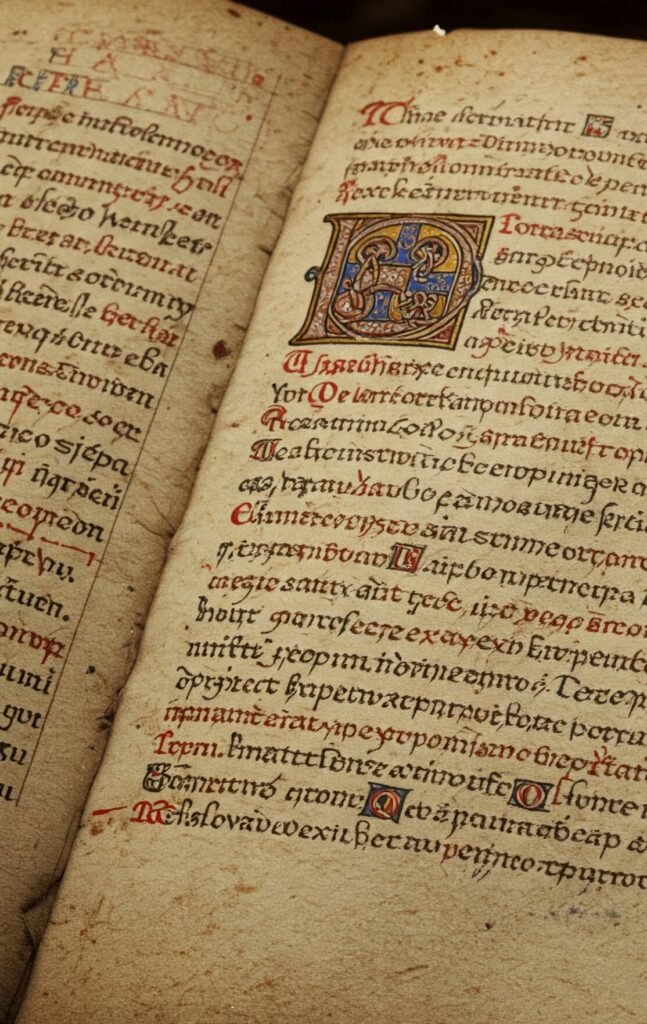
Brigid established a school of art encompassing metalwork, illumination, and manuscript production at her monastery. The Kildare scriptorium became celebrated throughout Christian Europe for the quality and beauty of its artistic work.
The most celebrated product of the Kildare scriptorium was the Book of Kildare, an illuminated manuscript of the Four Gospels whose beauty achieved legendary status. Gerald of Wales (Giraldus Cambrensis), the distinguished twelfth-century scholar and ecclesiastical writer, examined the manuscript personally and recorded his astonishment: “Nothing that he had ever seen was at all comparable to the ‘Book of Kildare,’ every page of which was gorgeously illuminated, and the interlaced work and the harmony of the colours left the impression that ‘all this is the work of angelic, and not human skill.'”
Tragically, this masterpiece of medieval Celtic Christianity vanished during the Protestant Reformation, like so much of our Christian history; it is lost forever.
Beyond manuscript copying, Kildare functioned as a pilgrimage destination of major importance. Cogitosus, an eighth-century monk of Kildare and hagiographer of Brigid, described the cathedral complex as magnificently appointed: “Solo spatioso et in altum minaci proceritate porruta ac decorata pictis tabulis, tria intrinsecus habens oratoria ampla, et divisa parietibus tabulatis” (a spacious foundation extended in threatening height and decorated with painted panels, having within itself three broad oratories divided by boarded walls).
The cathedral drew pilgrims from “all the provinces of Erin” (as Cogitosus noted), particularly on Saint Brigid’s feast day on February 14th, seeking healing through her intercessory power and spiritual blessing.
The Perpetual Flame: Sacred Fire and Spiritual Authority
Among the most distinctive features of Brigidine monasticism was the perpetual flame maintained at Kildare in the saint’s honour. According to Gerald of Wales, writing in the late twelfth century, nineteen nuns took turns maintaining a sacred fire that had burned continuously since Brigid’s time. Each nun would guard the fire overnight in turn, and on the twentieth night after each sister had completed her rotation, Brigid herself was said to appear to tend the flames.
Gerald preserved the ceremonial formula: “the nineteenth nun puts the logs beside the fire and says ‘Brigid, guard your fire, this is your night’. And in this way the fire is left there, and in the morning the wood, as usual, has been burnt and the fire is still alight.” The perpetual flame was ringed by a hedge through which no man was permitted to cross, making it an exclusively female sacred space.
In the modern era, the perpetual flame has been restored and is maintained at Solas Bhríde (the Centre of Spiritual Practices and Hermitages in Kildare), continuing a tradition that has now spanned over fifteen centuries.
Missionary Expansion and Continental Influence
According to the Trias Thaumaturga, Brigid spent time in Connacht and founded numerous churches, particularly in the Diocese of Elphin. She is said to have visited Longford, Tipperary, Limerick, and South Leinster, establishing religious communities and extending her monastic vision across multiple regions.
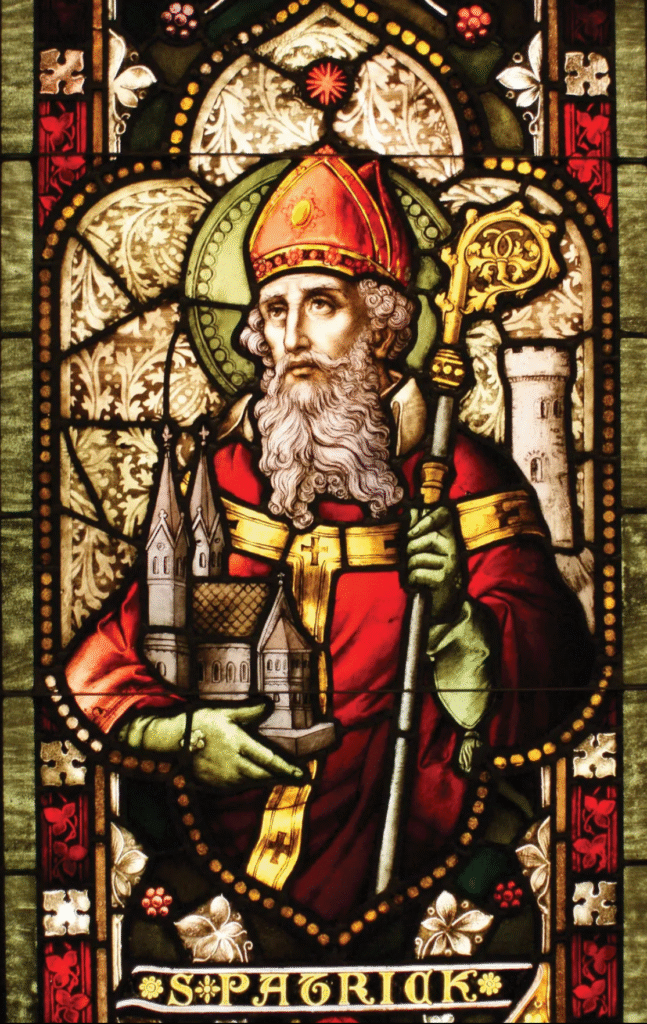
Her friendship with Saint Patrick is documented in the Book of Armagh, an eighth-century manuscript which records: “Between St. Patrick and St. Brigid, the pillars of the Irish people, there was so great a friendship of charity that they had but one heart and one mind. Through him and through her Christ performed many great works.”
Miracles and Spiritual Power
Brigid’s spiritual power characteristically expressed itself through healing the sick, feeding the hungry, and protecting the vulnerable from violence. Unlike Saint Patrick, whose miracles often concerned dynastic politics and ecclesiastical authority, Brigid’s interventions typically benefited ordinary people, particularly women and the poor.
Some of her miracles:
The Fire Healer: When approaching a healer for treatment of a severe headache, Brigid lodged with a Leinster couple possessing two mute daughters. During the journey, Brigid’s horse startled, causing her to fall and scrape her head on stone. A touch of Brigid’s blood from this wound healed the daughters of their muteness.
The Fisherman’s Discovery: A woman came to Brigid’s protection after being falsely accused of stealing a silver brooch that a nobleman had secretly thrown into the sea, intending to enslave her through fraudulent legal process. Brigid’s fishermen caught a fish in which the brooch had lodged; its recovery exonerated the woman and moved the nobleman to Christian conversion.
The Brewery Miracle: Brigid, skilled as both dairywoman and brewer, allegedly possessed the power to transform water into beer. A power most Irish would want!
Chastity Preserved: Brigid employed extraordinary spiritual power to aid a nun who had failed to maintain her vow of chastity and had become pregnant. Through Brigid’s blessed intervention and the woman’s subsequent penitence, the pregnancy disappeared without birth or pain, and the nun returned to health and renewed commitment to her vows.
Death and Veneration
Saint Brigid died at Kildare on February 1st, likely in 525. When she lay dying, she was attended by Saint Ninnidh of the Pure Hand, who subsequently had his right hand encased in metal to ensure it would never be defiled after administering the final sacraments to Ireland’s patroness.
Brigid was buried at the right of the high altar of Kildare Cathedral, with a costly tomb erected over her remains “adorned with gems and precious stones and crowns of gold and silver.” Her shrine became an object of veneration for centuries, drawing pilgrims especially on her feast day.
She was succeeded as Abbess of Kildare by Darlugdach, her beloved student and spiritual protégé. According to Brigid’s final prophecy, Darlugdach died exactly one year after her mentor, fulfilling the saint’s assurance that the devoted pupil would not long remain separated from her spiritual mother.
Relic History and Geographical Dispersal
Around 878, during the period of devastating Viking raids that imperilled Irish monastic centres, Brigid’s relics were transferred to Downpatrick in County Down, where they were interred in the same tomb as those of Saints Patrick and Columba. In 1185, John de Courcy, a Norman knight, claimed to have discovered the relics of all three patron saints. On June 9, 1186, the relics were solemnly reburied in Downpatrick Cathedral in the presence of Cardinal Vivian, fifteen bishops, and numerous abbots and ecclesiastics.
During the Tudor suppression of religious houses in 1538, the relics were desecrated, though Brigid’s head was preserved by certain clergymen who transported it to the Franciscan monastery of Neustadt in Austria. In 1587, it was presented to the church of the Society of Jesus in Lisbon (the Igreja de São Roque) by Emperor Rudolph II, where a portion of her skull is venerated to the present day.
Medieval tradition holds that another portion of Brigid’s skull reached Portugal much earlier, in 1283, supposedly carried by three Irish knights traveling to participate in the Aragonese Crusade and presented to King Dinis of Portugal. This relic is preserved in the Igreja São João Batista (Church of St. John the Baptist) in Lumiar near Lisbon, where it continues to be venerated on February 2nd (NEW CALENDAR).
Other relics exist but have less believable historicity. Unfortunately, in Western Europe there was a period of time after the catacombs had been rediscovered in Rome in which a bone was taken, given a name and a back story and sent out into the world as a “relic”. Due to this, the West has questionable relics.
Feast Day and Popular Devotion
Saint Brigid’s feast day of February 1st (NEW CALENDAR) which coincides with Imbolc, the pre-Christian Gaelic festival marking the beginning of spring and this has been observed since at least the seventh century, when Cogitosus first documented the celebration at Kildare.
The customs of Saint Brigid’s Day were not extensively documented until the early modern era, though they preserve ancient elements. The most prominent contemporary practice involves the weaving of Brigid’s crosses four-armed crosses made from rushes, hung over doorways and windows for protection against fire, lightning, illness, and evil spirits. On Saint Brigid’s Eve, tradition holds that the saint visits virtuous households and blesses inhabitants; families leave garments or strips of cloth outside overnight for Brigid to sanctify.
In Ireland and Scotland, girls and young women traditionally paraded a Brídeóg (“little Brigid”) around their neighbourhoods. A Brídeóg was a doll constructed from rushes or reeds, dressed in scraps of cloth, flowers, or shells. In some regions, a girl took on the role of Brigid herself, processed through the village wearing a rush crown and carrying a rush shield and Brigid’s cross, visiting homes to convey blessing and ward off evil spirits.
Historical Significance and Legacy
Saint Brigid represents one of the most influential female figures in medieval European Christianity. She stands as the pioneer of organised communal religious life for women in Ireland, establishing the first nunnery and creating the institutional framework within which countless subsequent Irish convent communities operated.
Her monastery at Kildare became one of the premier pilgrimage destinations in medieval Christendom, attracting the faithful from across Europe and generating both spiritual authority and material prosperity. The precedent of the Abbess of Kildare exercising superior jurisdiction over all Irish convent communities created a model of female institutional leadership that persisted for centuries which, of course, was a remarkable achievement in a predominantly male-led society.
The intellectual and artistic contributions of the Kildare scriptorium ensured Brigid’s monastery was a significant centre of learning and cultural production in the early medieval period. Beyond the physical monastery, Brigid’s influence permeates the Irish landscape through place-names: there are 45 townlands named Kilbride (from Cill Bhríd, “Church of Brigid”) distributed across 19 of Ireland’s 32 counties, along with Knockbridge, Toberbreeda, Brideswell, and dozens of other designations preserving her memory across the island.
Perhaps most profoundly, Saint Brigid embodies the synthesis of Celtic and Christian spiritualities that characterises early medieval Irish Christianity. Brigid served as a spiritual bridge connecting pagan Irish religious understanding with Christian theological advances while preserving continuities that made Christianity palatable and meaningful to a recently converted people.