Saint Fursey of Burgh Castle
Life Dates: c. 597 – 16 January 649 AD
A Missionary of the Heavenly Kingdom
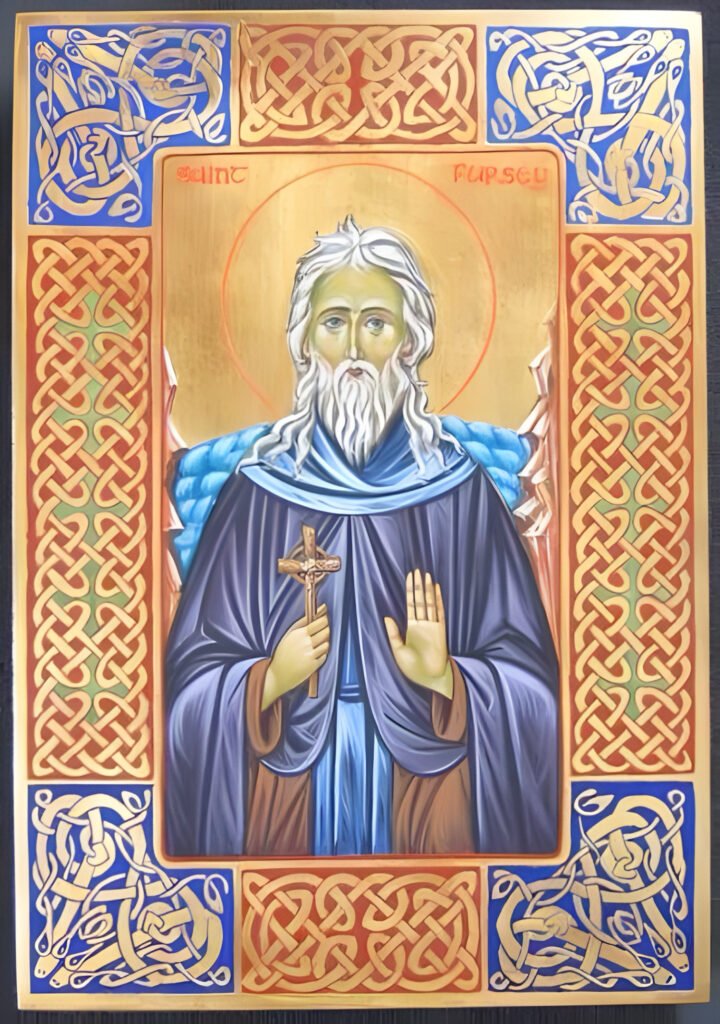
Saint Fursey (also spelled Fursa, Furseus; Irish: Fursa mac Fáeláin) is one of the most important men of Celtic Christianity, yet he is not as widely known as many of his contemporaries. He was a man whose visionary experiences of the afterlife profoundly shaped medieval Christian spirituality.
Fursey was born in Ireland around 597AD into a noble Christian family, he was the son of Fáelán and grandson of Maccaid, with two brothers: St Foillan and St Ultan both of whom would also become revered saints. His brother Ultan is not to be confused with Bishop Ultan of Ardbraccan. From his youth, Fursey was consumed by zeal for the Gospel and the ascetic life.
He first founded a monastery at Rathmat (modern Killursa) on Lough Corrib in County Galway, where he gathered disciples and lived a life of strict asceticism. But he could not contain the fire of missionary zeal within him and like many of Ireland’s best, he went abroad taking the path of white martyrdom. After receiving powerful visions of Heaven and hell, which he understood as a divine commission to preach repentance, Fursey crossed the sea to evangelise the pagan Angles of East Anglia.
King Sigeberht of East Anglia welcomed him and granted him land at Cnobheresburg (Burgh Castle in modern Norfolk), where he established a great monastery that became a beacon of Christian life in the region.
He didn’t stop there however, as he made his way to France where he fell asleep in the Lord at Mézerolles, France, on 16 January 649.
Veneration in the Orthodox Church
The Holy Orthodox Church venerates Saint Fursey as a pre-Schism Western saint and visionary, commemorating his feast on 16th January (New Calendar) / 29th January (Old Calendar). He is honoured not only as a missionary and monastic founder but as a seer of the heavenly mysteries, whose visions were granted by God to awaken sinners to repentance. Orthodox tradition holds him as a true prophet who beheld the unseen world and returned to bear witness to God’s mercy and justice.
His life is recorded in the Synaxarion as a model of spiritual warfare: he who confronted demonic powers, was purified by angelic ministrations, and preached the Gospel with power. He is invoked especially by those seeking spiritual discernment, by missionaries, and by all who desire to live in awareness of the eternal life to come.
Spiritual Labours and Ascetic Struggles
Saint Fursey’s life was a continuous battle for souls, fought through rigorous asceticism and unceasing prayer:
Fasting and Vigils: He observed such strict fasts and kept such prolonged vigils that his body was often weakened, yet his spirit burned brighter. He taught his monks that the belly must be controlled if the soul is to ascend to God.
Evangelistic Zeal: He left the security of his Irish monastery to preach among pagans, risking his life for the salvation of others. His missionary journeys took him through dangerous waters and hostile territories, yet he trusted in divine protection.
Spiritual Warfare: His visions revealed to him the reality of demonic assaults on souls. He taught his monks to arm themselves with prayer, humility, and the sign of the Cross, which he saw as the weapon that drives back the powers of darkness.
Miracles and Signs
A major part of Saint Fursey’s legacy is the series of extraordinary visions granted to him, which constitute some of the most detailed and influential accounts of the afterlife in early medieval Christianity.
The First Vision: The Four Fires of Judgment
While still in Ireland, Fursey fell deathly ill and was granted his first vision. He saw the soul of a man being judged and witnessed four great fires that would consume the world:
- The fire of Falsehood (lying tongues)
- The fire of Covetousness (greed and attachment to worldly goods)
- The fire of Discord (strife and division)
- The fire of Cruelty (harshness and lack of mercy)
An angel explained that these fires purify souls, burning away sins. Fursey himself was scorched by one of these fires when he tried to save a soul from torment, bearing a physical mark of the spiritual fire on his body for the rest of his life which is seen as a sign of his compassionate intercession even for the damned.
The Second Vision: The Journey Through Heaven and Hell
In a subsequent vision, Fursey’s soul was taken by angels on a tour of the afterlife. He saw:
The torments of the damned: Souls suffering according to their sins, some hanging by their tongues for false speech, others burning with insatiable thirst for covetousness, still others torn apart by demons for sowing discord. The vision terrifyingly depicted the eternal consequences of sin, serving as a powerful call to repentance.
The joys of the righteous: He beheld the saints in light, clothed in white garments, praising God unceasingly. He saw the Virgin Mary and the angels, and heard the heavenly liturgy that the Church on earth seeks to imitate.
The Third Vision: The Assault of Demons and Protection of Angels
During one ecstatic experience, demons attacked Fursey, trying to drag him to hell for his sins. But angels defended him, teaching him that the sign of the Cross is the invincible shield against demonic power. The demons were forced to confess their defeat, crying out that they could not overcome one who trusted in Christ’s Cross. This vision became a cornerstone of his teaching on spiritual warfare.
The Gift of Prophecy and Healing
Fursey possessed the gift of prophecy, foretelling events and calling sinners to repentance. He healed the sick through prayer and the laying on of hands, casting out demons and restoring health to both body and soul. His monastery at Burgh Castle became known as a place where miracles occurred regularly, as the prayers of the saint and his monks ascended to heaven.
Historical Sources
The primary source for Saint Fursey’s life and visions is the Vita Sancti Fursei, an early medieval hagiography that preserves the testimony of those who knew him.
The Venerable Bede, in his Ecclesiastical History of the English People, includes a summary of Fursey’s visions, confirming their authenticity and widespread influence.
Other sources include:
The Annals of the Four Masters and Irish genealogies that record his noble lineage and missionary activity.
Orthodox Synaxarion entries that preserve his feast and emphasize his role as a visionary saint.
Veneration Today
For Orthodox Christians, Saint Fursey is a powerful intercessor and a teacher of the reality of the unseen world. He is prayed to for intercession:
By those seeking spiritual discernment and protection from demonic assaults
By missionaries labouring to bring the Gospel to unbelievers
By the sick and suffering, that they may receive healing through his prayers
And, by all who wish to live with awareness of the eternal life to come
His monastery at Burgh Castle, though now ruins, remains a place of pilgrimage where the faithful can pray and remember that the saints of the early Church saw the heavens opened and beheld the glory of God.
Saint Fursey of Burgh Castle was a prophetic voice calling all Christians to remember the reality of the unseen world. His visions of the afterlife, granted by divine mercy, teach us that our choices in this life have eternal consequences.
For Orthodox Christians today, Saint Fursey stands as a guardian of the ancient faith, a witness to the continuity of the Church’s teaching on the soul’s journey after death, and a powerful intercessor who continues to pray for the salvation of the world. His life reminds us that the saints of the early Church were not distant figures but burning flames of divine love, and that we, too, are called to become partakers of the heavenly mysteries they beheld.