Saint Faolán also known as Fillan, Foillan, Faelan, and Foelan as an eighth-century Irish monk and missionary whose evangelistic labours in Scotland established him as one of the most venerated Celtic saints of medieval Caledonia. Born around 695 in Munster, Ireland, Faolán descended from Irish royal lineage: his father was Feriach, a prince or king of Dál Riata, while his mother was Saint Kentigerna, daughter of King Cellach Cualann of Leinster.
Faolán was born with a stone in his mouth and his father Feriach interpreted this as a curse rather than divine blessing. In a terrible act of paternal rejection, Feriach threw his son into a nearby lake. Miraculously, Faolán survived for an entire year in the water, sustained by angels. At the end of the year, a holy bishop called Saint Ibar received a divine revelation directing him to the lake, where he discovered the child playing with angels. Bishop Ibar rescued Faolán from the water, baptised him, and assumed responsibility for his upbringing and religious education.
Following his formation under Bishop Ibar, Faolán received the monastic habit at the Abbey of Saint Fintan Munnu (also called Taghmon Abbey) in County Wexford, one of the premier monastic centres of early medieval Ireland. There he was eventually elected abbot following the death of the blessed father Mundus. Although he accepted this honour reluctantly, in characteristic monastic humility.
Migration to Scotland
Around 717, Faolán departed Ireland for Scotland in the company of his mother Saint Kentigerna and his uncle Saint Comgan, undertaking the mission that would define his legacy. This family migration reflected the broader pattern of Irish Christians who abandoned their homeland for missionary work among less-evangelised populations- This practice is known in Celtic Christianity as “white martyrdom,” the voluntary exile from homeland and family for Christ’s sake.
The group initially settled at Loch Duich on the west coast of Scotland in what is now the northwest Highlands. There, Faolán’s mother Kentigerna started her missionary work around Loch Lomond, eventually retiring to the island of Inchcailloch (Island of the Old Woman) where she founded a convent and lived out her final years in sanctity. His uncle Comgan established himself at a location called Siracht (or Sirach) in the upper parts of Glendochart, where he led a monastic community.
Foundation at Strathfillan
Following an angelic revelation directing him to join his uncle Comgan, Faolán traveled to Glendochart in the uplands of Perthshire, where he received divine guidance indicating the precise location where he ought to build a monastery. The site which was subsequently known as Strathfillan (the valley of Fillan) became the centre of his missionary labours.
Faolán arrived at Strathfillan accompanied by seven clerics who would assist in the construction of the basilica and the evangelisation of the surrounding population. The region was still heavily influenced by paganism, and Faolán’s missionary work involved both the dramatic confrontation with pagan practices and the patient work of catechesis and conversion.
While constructing the church, Faolán encountered a ferocious wild boar that had devastated the district, terrorising the local population. Accompanied only by his small dog, the saint drove away the beast through spiritual authority, demonstrating divine power over the forces of nature. This miracle served both practical and theological purposes: it protected the population from genuine physical danger while simultaneously demonstrating Christianity’s superiority over the demonic forces that paganism could not control.
The Miracle of the Wolf and The Ox
Another remarkable miracle occurred during the construction of the Strathfillan church. The oxen used to draw wagons carrying building materials were unyoked at the end of a day’s work, and during the night a hungry and fierce wolf attacked the herd, killing and devouring one of the oxen. In the morning, discovering the loss and having no replacement animal to pull the heavy loads, Faolán poured forth fervent prayer to God.
Miraculously, the same wolf that had slaughtered the ox returned to the construction site, but now transformed in disposition: it voluntarily “submitted himself to the yoke with the oxen” and laboured obediently alongside the remaining cattle, pulling the wagons until the church’s completion. Once the basilica was finished, the wolf returned to the wild without harming anyone.
The Miracle of The Glowing Arm
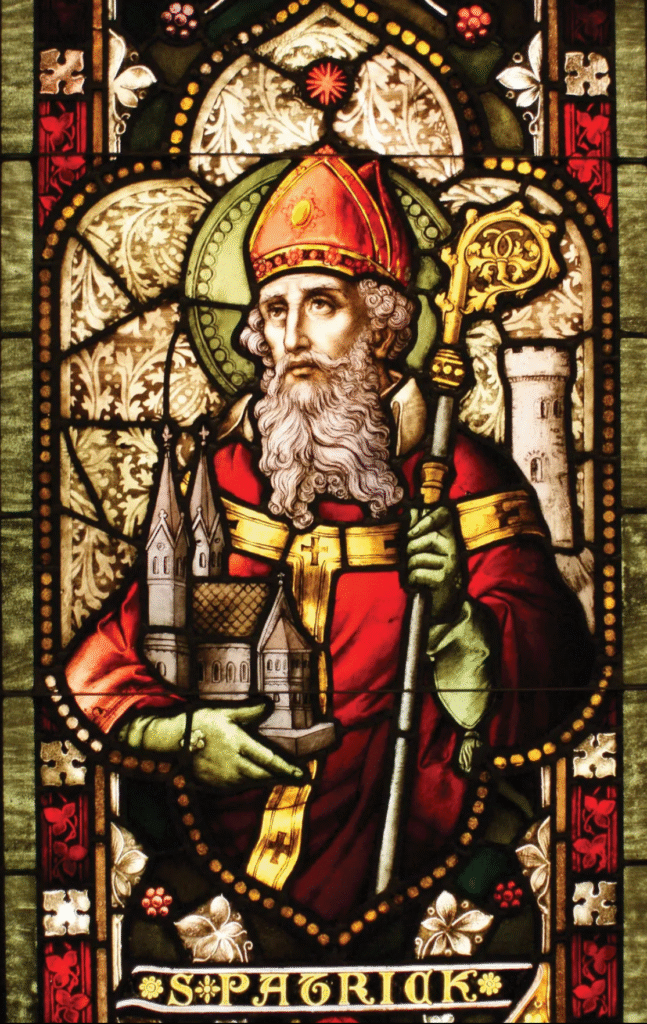
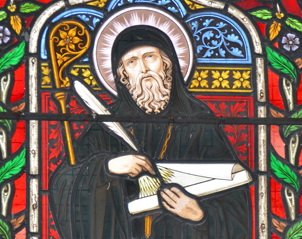
One of Saint Faolán’s greatest miracles was the luminescence of his left arm, which reportedly glowed with brilliant light during the night hours, illuminating his manuscripts and enabling him to continue his scribal work of copying sacred texts without need of candle or lamp. This miracle is recorded in multiple contemporary sources and it groups Faolán with other Celtic saints whose bodies manifested divine light – St. Patrick did something similar.
Life as a Hermit
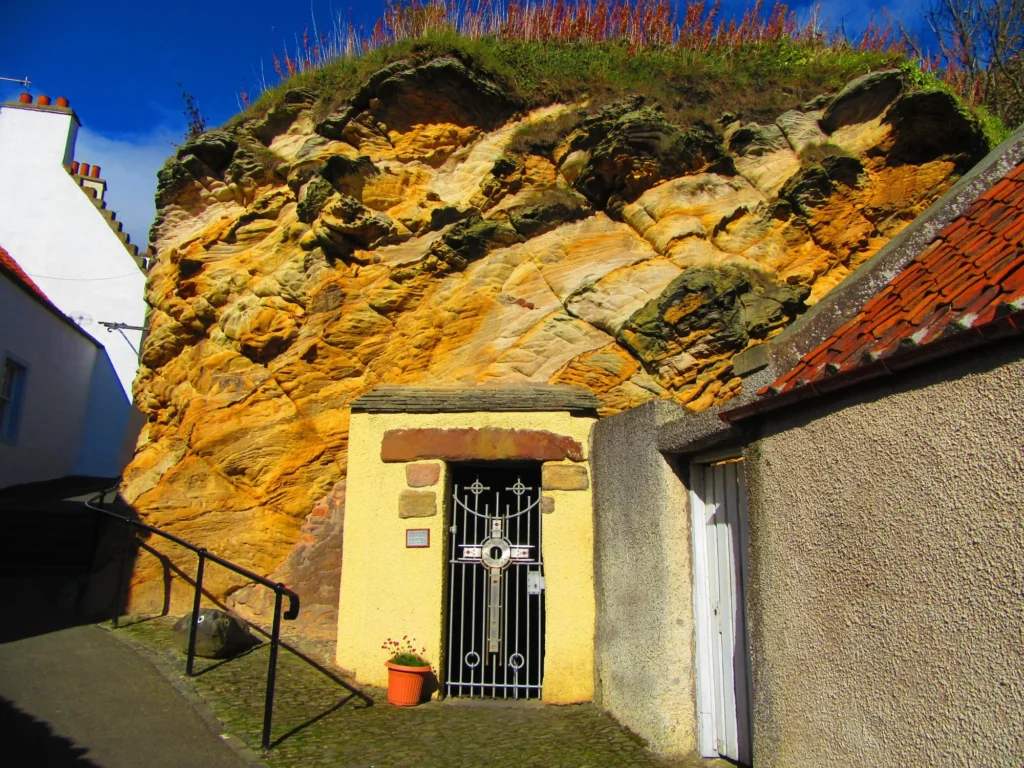
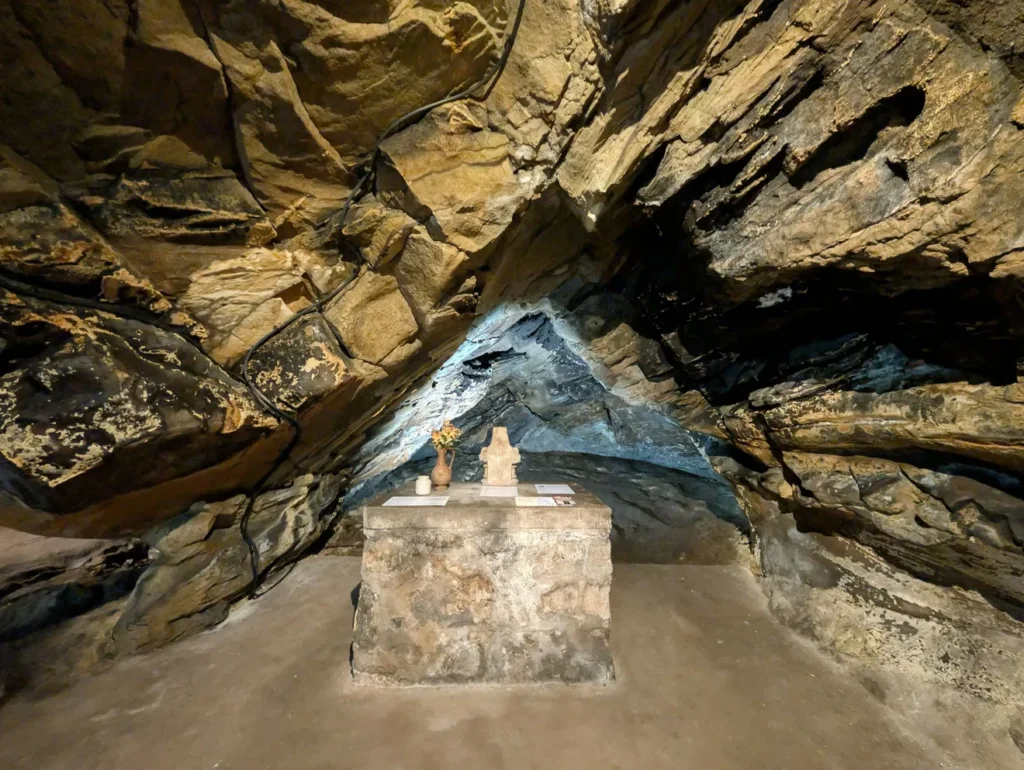
Later in his monastic life, Faolán withdrew from his community at Strathfillan to embrace the hermitic path, building a cell in a cave at Pittenweem in Fife, on the eastern coast of Scotland. This coastal cave which is dramatically situated overlooking the North Sea became Faolán’s place of spiritual struggle and ascetic discipline during the final phase of his life. The cave survives to the present day and functions as a shrine dedicated to Saint Faolán.
Legacy
Beyond his principal foundation at Strathfillan and his hermitage at Pittenweem, Faolán established or inspired the dedication of churches across multiple regions of Scotland. Churches bearing his name were founded in Galloway in southwestern Scotland and on the island of Islay in the Inner Hebrides, testifying to the reach and his influence in Scotland.
The River Fillan and Strathfillan preserve his name in the Scottish landscape. The village of St. Fillans in Perthshire similarly remembers the saint.
Repose, Burial, and Veneration
Saint Faolán died around 770 in Strathfillan, and was buried in the church that he had founded. His tomb became an object of veneration, and his relics were preserved with great care by successive generations of Scottish Christians.
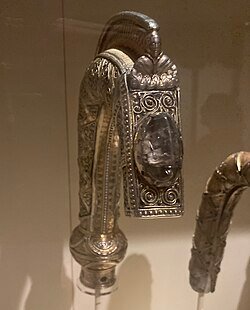
His most famous relics were his pastoral staff (crosier), known as the Quigrich, and a healing stone called “Fillan’s Rock” or the “Bernane,” believed to possess miraculous curative properties. Additionally, a sacred bell associated with the saint was preserved and became an object of pilgrimage.
Saint Fillan’s Well, a holy spring at Strathfillan, achieved extraordinary fame throughout medieval Scotland for the numerous miraculous cures attributed to pilgrims who bathed in its waters or drank from it. The well became particularly associated with the healing of mental illness, with sufferers of madness brought to the site for immersion in the sacred waters which is a therapeutic practice that has continued into the modern era.
Feast Day and Patronage
Saint Faolán’s feast day is observed on January 22nd on the Old Calendar. Saint Faolán serves as patron saint of the mentally ill, owing to the tradition of healing madness through immersion in Saint Fillan’s Well. He is also invoked by those suffering from rheumatism and is recognised as the patron saint of Strathfillan and the surrounding region of Perthshire.