St. Columba of Iona: Apostle to Scotland
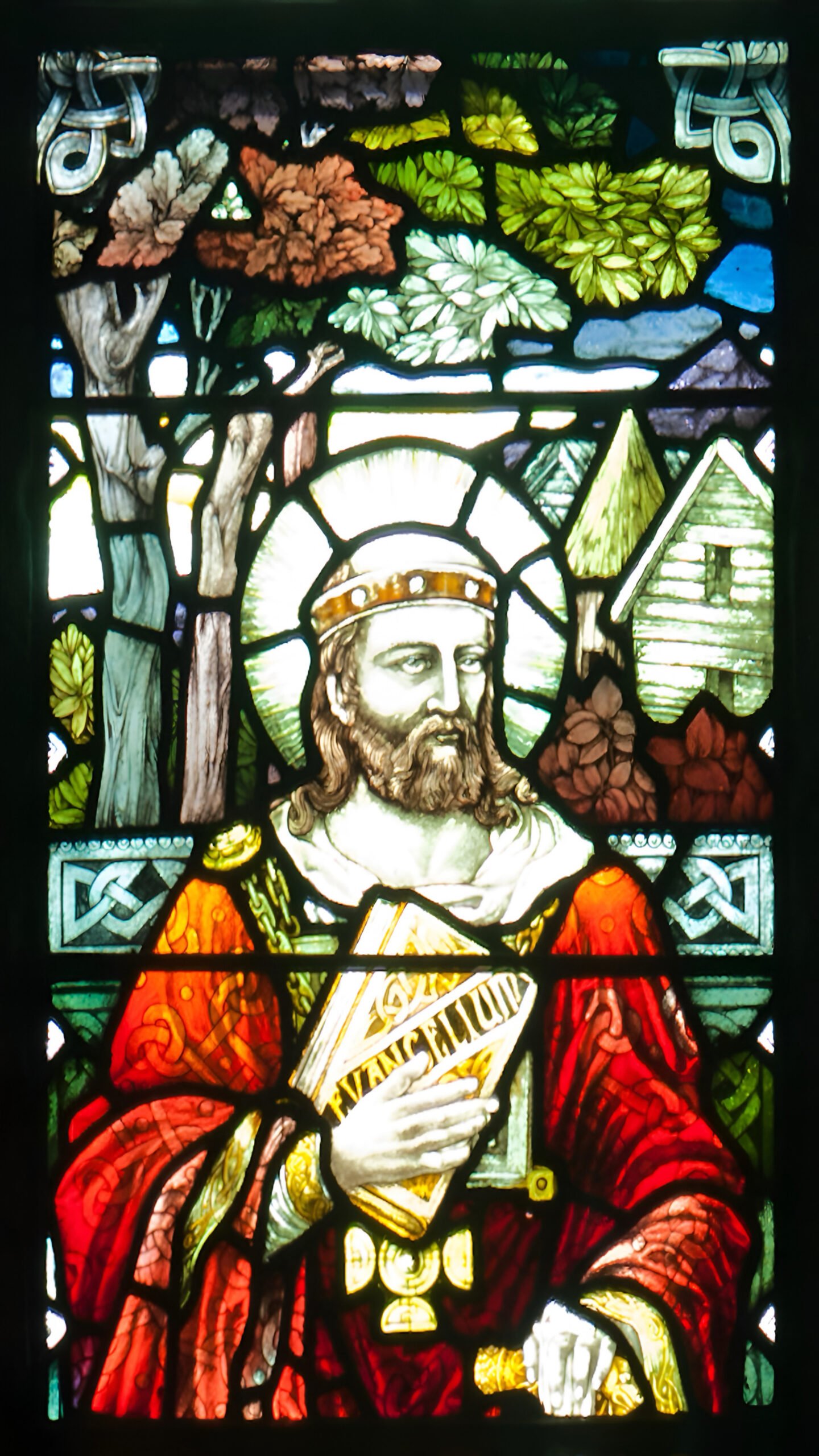
Saint Columba (c. 521–597), known in Irish as Columcille (the dove of the church), stands as one of the three patron saints of Ireland alongside Patrick and Brigid, and as the primary founder of organised Christianity in Scotland. His establishment of the monastery at Iona around 563 transformed an obscure Inner Hebridean island into the spiritual heartland of Celtic Christianity, from which missionaries would eventually Christianise the northern Picts, the Gaels of Dál Riata, the northern English, and ultimately entire regions of continental Europe.
Origins and Noble Lineage
Saint Columba was born on December 7, 521, in Gartan, County Donegal, Ireland, into one of the most powerful noble families of early medieval Ireland: the Uí Néill dynasty, which traced its descent from Niall of the Nine Hostages, the legendary High King of Ireland who died around 450. His parents were Fedelmid mac Ferguso and Eithne, placing Columba within a family nexus of extraordinary political and military authority.
The name Columba itself derives from his original given name Colum, meaning “dove” in Irish. Later people added Cille (church), giving him the new name Columcille, which in Latinised form became Columba. The dove symbolised innocence, gentleness, and the Holy Spirit, which is funny because Colum Cille’s temperament was famously fierce, fiery, and stubborn in authority.
Early Formation and Monastic Foundation in Ireland
Columcille’s childhood was spent immersed in Christian culture within his family household which was still somewhat unusual in Ireland at that time. This placed him among the first generation of Irish nobility raised entirely within Christianity but if you have read our Life of Patrick you will learn more about the conversion of the Uí Néill family.
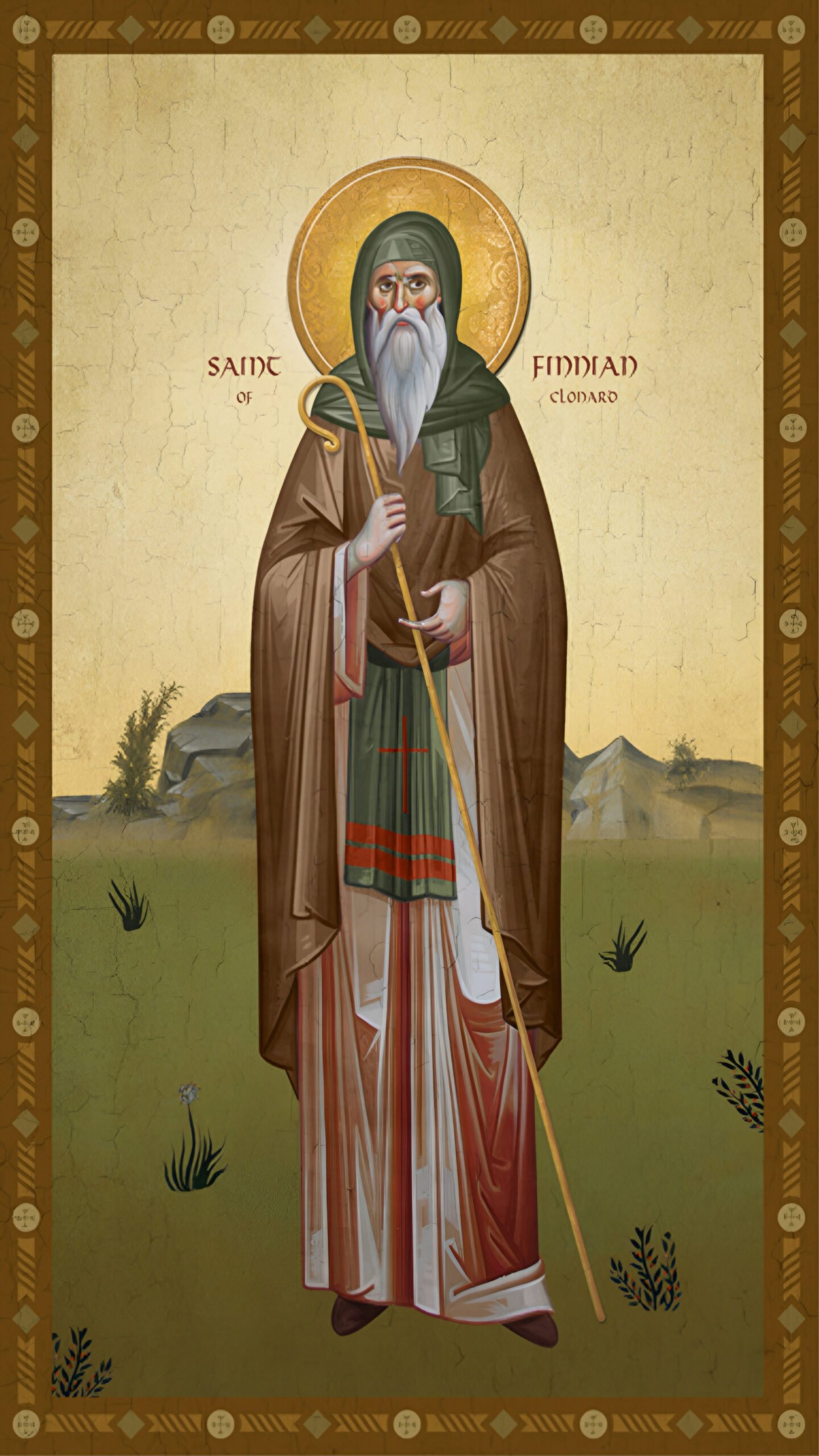
In his teenage years, he entered the monastery where he studied under some of Ireland’s most famed ecclesiastical figures, including Saints Finnian of Moville and Finnian of Clonard, and was ordained a priest around 551.
Columcille was immensely gifted in poetry, music, manuscript copying, and theological learning. But his prodigious talents didn’t stop there – by the time he reached his mid-twenties, he had already begun establishing monastic foundations throughout Ireland, bringing his own spiritual vision to the next generation. By age 25, he had founded approximately 27 monasteries in Ireland which even for that time is an extraordinary achievement.
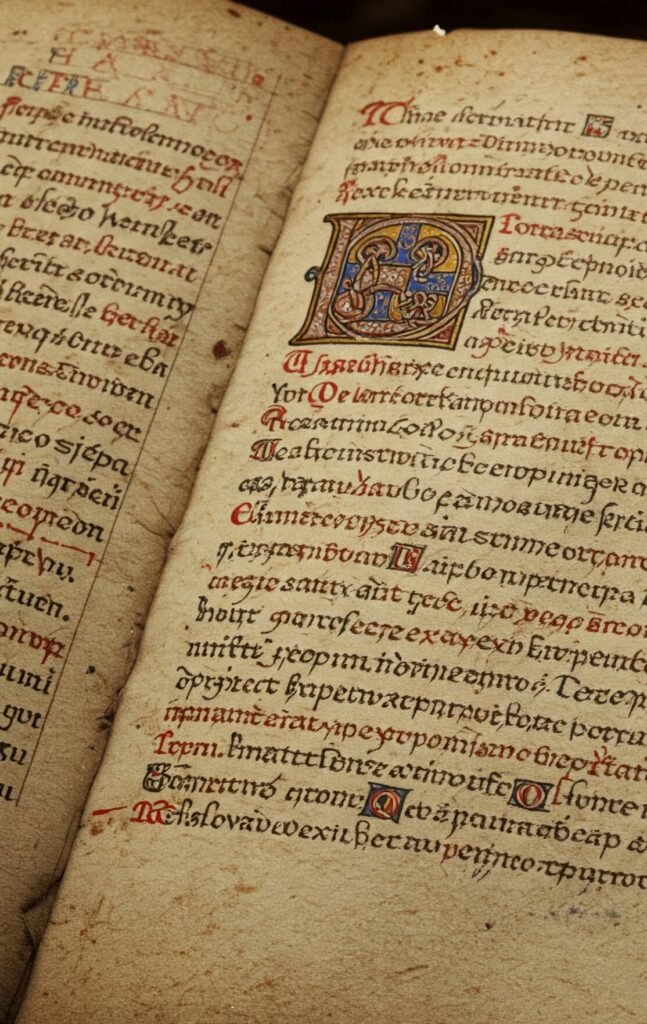
Columcille chose the sites for his monasteries very carefully. For example, he established the monastery at Derry (Daire Calgaich, “oak grove of Calgach”) around 546, on an ancient druidic site that the population already recognised as sacred. This is a tactic he used for many of his monasteries which helped to facilitate Christian conversion by maintaining geographical and spiritual continuity with pre-Christian religious belief. He also founded Durrow (Dairmagh, “oak grove”) and established a religious community at Ceanannas Mór, which would later develop into the celebrated monastery at Kells, home to one of Christianity’s most famous manuscripts. The book of Kells today can be found in Trinity College library in Dublin.
The construction of approximately 40 churches and his reported founding of around 100 religious communities throughout Ireland earned Columcille a reputation as one of the most prolific monastic founders in Irish history. His literary and artistic credentials were equally impressive: he was renowned as a scholar who had transcribed approximately 300 books, and three surviving early-medieval Latin hymns are attributed to him.
The Battle of Cúl Dreimhne: Conversion and Exile
At the age of 42 Columcille would get caught up in a disagreement over the copying of a psalter. This would result in war that Columcille had a hand in starting.
According to the most reliable accounts, Colum Cille had borrowed a psalter belonging to Saint Finnian of Moville. Without permission, Columcille secretly copied the manuscript, and when Finnian discovered the unauthorised duplication, he demanded that Columba surrender the copy, arguing that the transcription belonged rightfully to him who owned the original. Columba refused, asserting that as the scribe who had produced the copy through his own labor, he retained ownership of his work.
The dispute escalated beyond personal disagreement into a matter of dynastic honour when Colmcille’s kinsmen of the Uí Néill clan became involved. At this time, Ireland was still divided into many kingdoms and war over trivial disagreements were not uncommon. Finnian and Columcille brought their case to the high king – Diarmait mac Cerbaill. Columcille being anything but a shrinking violet offered passionate denunciation of injustice by king Diarmait mac Cerbaill when he ruled in Finnian’s favour, sparking a serious conflict.
This led to Columcille calling in his relatives, who were a very strong clan. There was tension before this dispute between Columcille and the high king Diarmait due to the king’s unjust treatment of a fugitive who had sought Columcille’s monastic protection which was a violation of ecclesiastical sanctuary which was becoming a norm in Ireland at that time. Therefore, Columcille seemingly went into this dispute already fired up and when Diarmait ruled against him on the copyright issue he wasn’t pleased.
Columcille’s relatives, stirred by his anger and passionate rhetoric, rose in arms against the high king, drawing other clans and noble families into the conflict. The result was the catastrophic Battle of Cúl Dreimhne, fought in 561 in what is now County Sligo. The battle resulted in a horrifying carnage: thousands of Christian warriors perished in combat that Columcille himself had arguably precipitated through his refusal to compromise and his inflammatory rhetoric to his kinsmen.
The horror of the massacre crushed Columcille’s conscience. Columcille fell into profound remorse, consumed by the weight of responsibility for the bloodshed he had caused. The Church turned against him; many of his contemporaries condemned him as a man whose pride and stubbornness had led to mass death and a synod of Irish bishops considered imposing severe penance upon him, possibly including permanent excommunication.
In the face of this condemnation and internal spiritual crisis, Columcille resolved upon an extraordinary act of penance: he would leave Ireland, entering what he conceived as a form of spiritual exile that would require him to compensate for each life lost in the battle by winning an equivalent number of souls to Christ through missionary labours.
The Voyage to Iona: Foundation of the Monastic Powerhouse
In 563, Columcille made his fateful decision to sail westward to Scotland. Accompanied by twelve disciples he crossed the Irish Sea in a small currach, a traditional Celtic vessel of wood and hide, and landed in the region of Dál Riata, the Irish kingdom that had established settlements on the Scottish mainland and islands.
The island he selected as his monastic base was Iona (then known as “Hy” or “Hii,” with “Iona” only becoming the accepted name from a 14th-century misreading of Latin transcriptions). Iona is a small, desolate island approximately three miles long and two miles wide, situated off the southwestern coast of the Isle of Mull in the Inner Hebrides.
Columba and his companions immediately set about constructing a monastic establishment on the barren island. They erected simple cells constructed from stone and wood, built a chapel, and began the routines of monastic prayer, manual labor, and spiritual discipline that characterised Celtic monasticism. The monks constructed a vallum (enclosure bank) that surrounded the entire monastic settlement, creating a sacred boundary between the holy space of the monastery and the secular world beyond.
Expansion of the Ionan Confederation: Monastic Network
Under Columcille’s leadership, Iona rapidly evolved from an isolated hermitage into the administrative and spiritual centre of an expanding network of monastic dependencies and missions. By 574, merely eleven years after the initial foundation, Columcille had established at least one subsidiary monastery on the island of Hinba, and other dependencies followed across the Hebridean islands, all maintained under the spiritual and jurisdictional authority emanating from Iona.
The monastic complex that Columcille developed on Iona functioned as a missionary training centre and scriptorium. The monastery became renowned for the quality of its manuscript production, contributing significantly to the traditions that would result centuries later in famous manuscripts such as the Book of Kells and the Lindisfarne Gospels.
Iona also functioned as a launching point for missionary expeditions throughout Scotland. Columcille sent out missionaries to establish churches and monastic communities among the Picts, the dominant people of northern and eastern Scotland, among the Gaels of Dál Riata, and among the northern English tribes. The monastery also maintained links with those in Ireland, preserving Columcille connection to the ecclesiastical structures he had he left behind in Ireland.
Missionary Activity Among Picts and Political Authority
Columcille’s missionary work was more than simple preaching and building churches but also included engagement with pagan rulers whose conversion he pursued. The most celebrated recorded missionary encounter involved Columcille’s meeting with King Bridei mac Maelchon, the pagan ruler of Fortriu (the dominant Pictish kingdom), at his fortress near Inverness.
Columcille journeyed from Iona to Inverness to meet the pagan king, whose dominion extended across much of what is now northern and central Scotland. Columcille offered miraculous displays of spiritual authority before Bridei. One such miracle was when the saint drove away a mysterious water creature deep into the river Ness – perhaps the start of the Loch Ness monster myth! This monster had supposedly killed a Pict and attacked Columcille’s disciple Lugne. Despite the good showing Bridei appears not to have formally converted to Christianity.
Nevertheless, Columcille won the king’s respect and achieved a working diplomatic relationship that facilitated Christian missionary activity throughout the Pictish kingdom. This pattern, that is: the conversion of tribal leaders or at least their neutralisation through a combination of spiritual authority, diplomatic acumen, and displays of miraculous power were repeated by Columcille through his missions and they reflect the same tactics used by St. Patrick not so long before in Ireland.
The Vita Columbae: Adomnán’s Hagiographical Testament
The fullest surviving account of Columcille’s life comes from the Vita Columbae (Life of Columba), composed by Adomnán, Columcille’s ninth successor as Abbot of Iona and one of the most accomplished scholars and ecclesiastical administrators of the seventh century. Adomnán, writing approximately a century after Columcille’s death, had access to oral traditions, earlier written accounts, and institutional memory preserved within the monastic community.
The Vita Columbae presents Columcille as a figure of extraordinary spiritual authority, characterised by fierce determination contrasted with pastoral gentleness, and an unwavering commitment to monastic discipline. The hagiography describes miracles of healing, exorcism, prophecy, and knowledge bestowed by grace, as well as accounts of Columcille’s role in political affairs and Church diplomacy along with details of his monastic community and his disciples.
The Vita Columbae remains one of the most important sources for understanding sixth and seventh-century Scottish history, Pictish culture, political structures, and the missionary activity of Celtic Christianity. Modern scholars recognise Adomnán as a careful and generally reliable witness to Columba’s basic biography.
Columcille’s Literary and Artistic Legacy
Columcille is credited with having personally transcribed approximately 300 books.
He penned three early-medieval Latin hymns which are among the oldest surviving Irish religious poetry. His reputation as a poet extended into the vernacular Irish tradition, where numerous poems are attributed to him.
The scriptoria established at Iona under Columcille’s direction contributed substantially to the development of the artistic techniques, paleographical styles, and illumination methods that would characterise the style of Celtic manuscript culture in the seventh and eighth centuries.
Repose and Prophecy
Columcille experienced a vision in which angels came to receive his soul and convey him to heaven. In the vision, Columba was filled with joy at the prospect of his departure, however his joy was short lived when the angels told him that his death would be delayed four additional years..
The prophecy proved accurate. Four years later, in the spring of 597, as Easter approached and Columcille longed for union with Christ, he prepared to depart this life. The saint did not want to repose on Easter Sunday, as he did not want to overshadow the paschal joy of his disciples with the sorrow of his death. Therefore, his death was delayed until after Easter, allowing the community to celebrate the Resurrection joyfully before the repose of their beloved abbot.
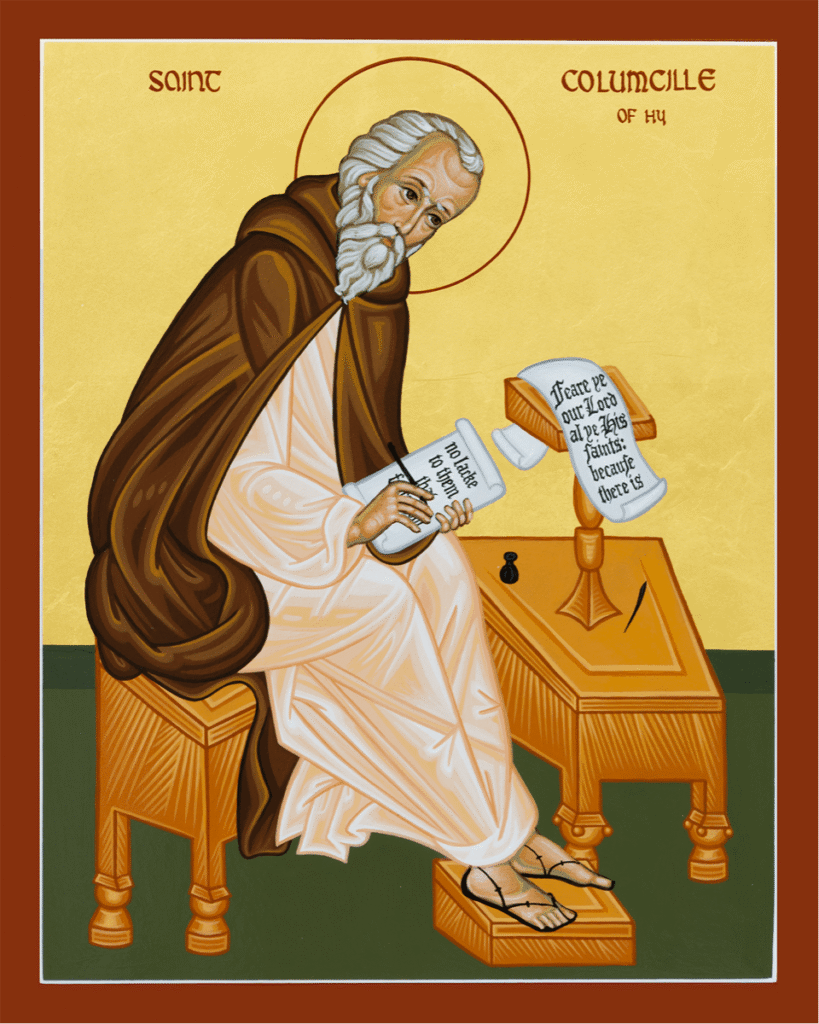
On June 9, 597, Columcille fell asleep in the Lord at his monastery on Iona. In his final hours, Columcille returned to his cell to continue copying the Psalms, specifically Psalm 33, reaching the verse: “The rich have become poor and hungry; but those who seek the Lord diligently shall not want any good thing.” At the verse’s conclusion, he set down his quill, instructing his successor to complete the remainder of the work, then ascended to the altar for the final celebration of the liturgy before dying peacefully in his cell.
Relic Translation and Viking Disruption
Following Columcille’s repose, his shrine at Iona became an object of intense veneration, attracting pilgrims from across Scotland, Ireland, and the continent. The monastery’s fame as a centre of learning and Christian sanctity spread throughout Christian Europe, and the island became designated as a burial ground for kings of Scotland, Ireland, and even Norway!
However, this prestige and the monastic wealth that accompanied it made Iona vulnerable to Viking raiders who systematically attacked Scottish and Irish monastic centres from the late eighth century onward. The monastery experienced the first major Viking assault in 795, but the most devastating raid occurred in 806, when approximately 38 monks were slaughtered by Norse raiders. This catastrophic violence prompted many of Columcille’s monks to return to Ireland, establishing a second monastery at Kells where they preserved and continued the artistic traditions of Iona.
Despite the violence, some monks remained at Iona or returned to rebuild, but the island never fully recovered its earlier prominence. St. Blathmac and other monks who had returned were martyred in a second raid in 825 when the monastery was burned.
Historical Significance and Legacy
The island of Iona continues today as a pilgrimage destination attracting thousands of visitors annually who come to pray, worship, and walk the landscapes hallowed by Columcille’s presence and the community he founded. The Iona Community, established in 1938 by the Church of Scotland minister George MacLeod, explicitly sought to recover and embody the spiritual and social vision of Columba, demonstrating the continuing resonance and relevance of the sixth-century saint’s legacy to contemporary Christian faith and practice.