Early Life
Óengus of Tallaght – March 11
Our Venerable Father Óengus of Tallaght, a holy bishop and God-inspired writer of Ireland, is chiefly known to us for his sacred works, the Félire Óengusso (Martyrology of Óengus) and possibly the Martyrology of Tallaght. Through his unwavering dedication to Christ, he became a powerful instrument for the renewal of Irish monasticism, guiding many souls towards greater holiness.
Born in the region of Clonenagh, in County Laois, not far from the town of Mountrath, the time of his earthly birth remains unknown to us. From a young age, he was nurtured in the spiritual life within the monastic school founded by the devout Fintan of Clonenagh, under the guidance of the venerable Abbot Maelaithgen. Though he humbly referred to himself as a “pauper” in his Martyrology, this was not a reflection of earthly poverty, but rather a sign of his profound humility and his fervent embrace of evangelical poverty, renouncing worldly gain for the spiritual riches found in Christ.
Monastic Life & Félire Óengusso
He became a significant member of the monastic community established by the holy Máel Ruain in Tallaght, a place that, through God’s providence, has grown into a large district of Dublin, enduring and expanding even to this day.
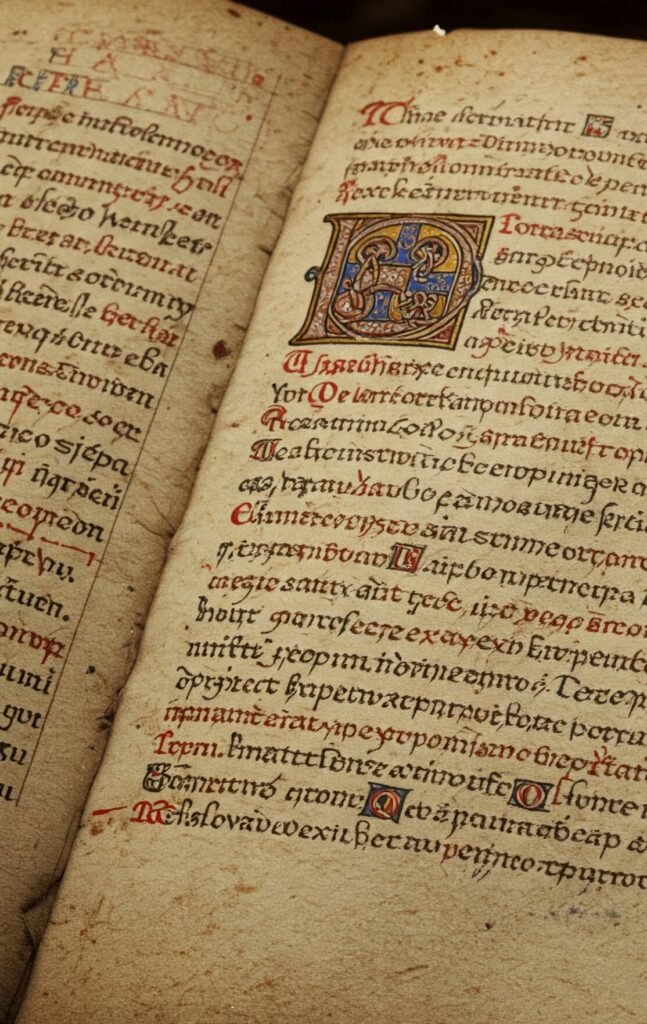
The Félire Óengusso stands as his most renowned work. It is a sacred register of Irish saints, composed of 365 quatrains, offering a commemoration for each day of the year. By God’s grace, at least ten manuscripts of this precious martyrology have been preserved for us.
Composed towards the end of the eighth century or the dawn of the ninth, the Félire Óengusso bears remarkable testimony to the rapid blossoming of Christianity in Ireland. Considering that the zealous mission of Saint Patrick began only around 432 – building upon the earlier efforts of Saint Palladius – this martyrology reveals that within a mere three and a half centuries, Ireland had produced hundreds of known saints, not to mention the countless others known only to God.
In the Félire Óengusso, Saint Óengus demonstrates his spiritual detachment from worldly power and transient earthly gains. He contrasts the fallen sites of pagan kingdoms, such as Tara, Crúachan, and Navan Fort, with the enduring and powerful centers of spiritual wisdom that flourished in his time, like Armagh and Clonmacnoise, thus highlighting the eternal nature of God’s Kingdom over fleeting earthly dominion.
Life As A hermit
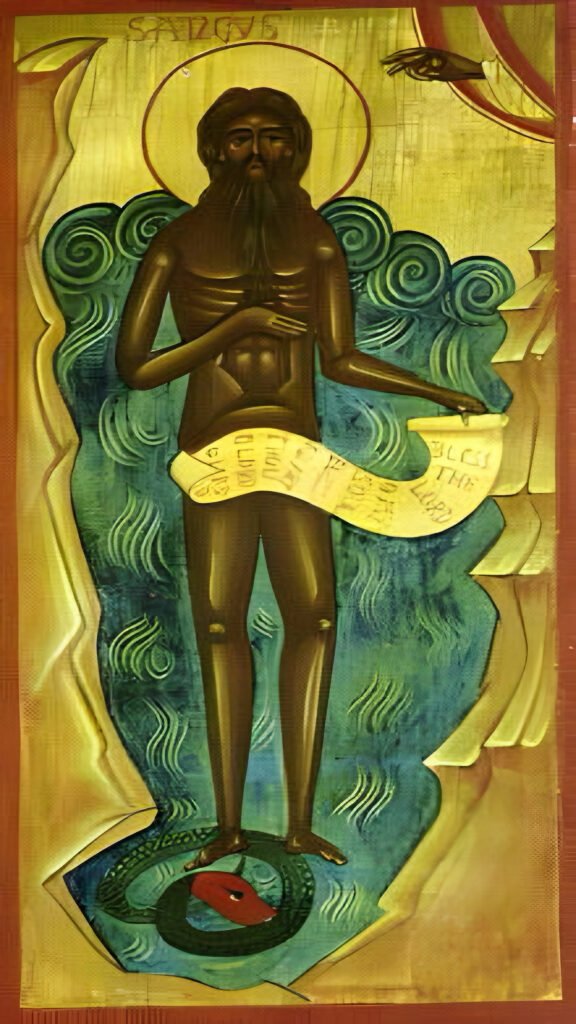
For a period of time, Saint Óengus lived as a hermit in Disert-beagh, where it is recounted that he was granted the grace to commune with the holy angels by the bank of the River Nore. Such was his deep love for prayer and solitude that he earned the spiritual nickname ‘Ceile Dé’, meaning ‘Servant of God’. Yet, in his profound humility, he held the lowest opinion of himself, allowing his hair to grow long and unkempt and wearing ragged clothes, desiring that people might look upon him with disdain rather than adulation.
His fervent yearning for solitude and the desire to escape the admiration of others eventually compelled him to leave his first hermitage, situated only a mile from Clonenagh, as souls continually sought him out for spiritual help and guidance. In his pursuit of deeper solitude, he moved a further eight miles away to a place that became known as The Desert of Óengus.
There, he built a humble oratory where he dedicated himself to a life of intense prayer and ascetic struggle. Today, only the ruin of a later structure remains upon the site of his sacred cell. In this holy place, he lived a life of rigorous discipline, performing three hundred prostrations daily and reciting the entire Psalter each day, often enduring part of this prayer immersed in cold water, tied by the neck to a stake – a testament to his extraordinary spiritual подвиг (podvig, spiritual struggle).
Hermitages & Divine Insight
Despite his love for solitude, Saint Óengus was also instrumental in founding at least two more monastic communities in Ireland, both known as “Óengus’ Hermitage.” However, no matter where he sought seclusion, souls drawn by God’s grace found him. Therefore, in an act of profound humility and obedience, he withdrew to Tallaght and entered the monastery of Saint Máel Ruain, not as a renowned scholar, but as a simple lay brother. For seven years, he undertook menial tasks, hidden from the recognition he so humbly sought to avoid. It was during this time that a young boy sought refuge in the stable where Saint Óengus was working, lamenting his inability to learn his lessons. The saint, moved by compassion, lulled the boy to sleep, and upon awakening, the youth found he could miraculously recall all that he had studied.
Through this divine sign, Saint Máel Ruain came to know the true identity of the hidden ascetic. Recognizing the grace upon him, they collaborated on the Martyrology of Tallaght, becoming close spiritual friends. Saint Óengus’s gifts for teaching and spiritual guidance became invaluable to the monastic community, helping many on their path to salvation.
During his time in the monasteries, he became a driving force behind a more disciplined form of asceticism and a deeper commitment to sacred learning. The form of monasticism he fostered gave rise to communities of anchorites living together, often in groups of thirteen, symbolizing Christ and His twelve Apostles. His followers, known as the Culdees (meaning ‘Servants of God’ – the anglicised form of Ceile Dé), produced the exquisite illuminated manuscripts and the highly decorated Celtic Crosses for which Celtic Orthodoxy is celebrated even unto this day.
Upon the repose of Saint Máel Ruain in 792, Saint Óengus departed from Tallaght and returned to Clonenagh, succeeding his former teacher, Maelaithgen, as abbot. Sensing the approach of his own departure from this earthly life, he retired once more to his beloved hermitage to prepare his soul for its journey to the heavenly Kingdom.
Saint Óengus’s feast day is observed on the 11th of March. The ancient poem Aíbind suide sund amne recounts that he reposed on a Friday at his hermitage. The exact year of his blessed death is not definitively known, but it is believed to be around 819, 824, or 830. He was laid to rest in his place of spiritual birth, Clonenagh.
The following is a literal English translation of the poem written by the holy Óengus, the original being in the Irish tongue.
Sanctify, O Christ ! my words:
O Lord of the seven heavens !
Grant me the gift of wisdom,
O Sovereign of the bright sun !
O bright son who dost illuminate
The heavens with all their holiness !
O King who governest the angels !
O Lord of all the people !
Lord of the people,
King all-righteous and good !
May I receive the full benefit
Of praising Thy royal hosts.
Thy royal hosts I praise
Because Thou art my Sovereign ;
I have disposed my mind,
To be constantly beseeching Thee.
I beseech a favour from Thee,
That I be purified from my sins,
Through the peaceful bright-shining flock.
The royal host whom I celebrate.”